

How often do you Google something? What do you tell Google, and what does it know about you? Check out this resource from Tactical Tech on Google Society.
Could you think about how many Amazon products you carry on your phone? Or the role Microsoft plays in your life? What about other companies like Meta, Alibaba or Reliance?
Get together in a group of your family, friends, classmates, and/or co-workers and carry out the following activity.
Data Rights Debate: Remote Proctoring in Education
AI-based remote proctoring is a technology-driven approach to monitoring and invigilating online exams. It involves the use of AI algorithms to assess and analyze various aspects of a test-taker’s behavior, facial expressions, and surroundings during an online examination. The goal is to ensure the integrity of the exam process by detecting any potential cheating or irregularities. This technology often incorporates features such as facial recognition, eye tracking, and behavior analysis to maintain the security and fairness of remote assessments.
The issue of remote proctoring in exams has sparked debates due to concerns about privacy invasion, potential algorithmic biases, and the collection of personal data. Balancing the need for exam integrity with safeguarding students’ data rights has become a central challenge, prompting discussions on fair assessment practices in online education.
Activity Overview: For this activity, you will carry out a mock TV news debate on the issue.
Moderation: This activity would be best suited to be carried out under the guidance of a moderator; this could be a teacher, a parent or a community leader.
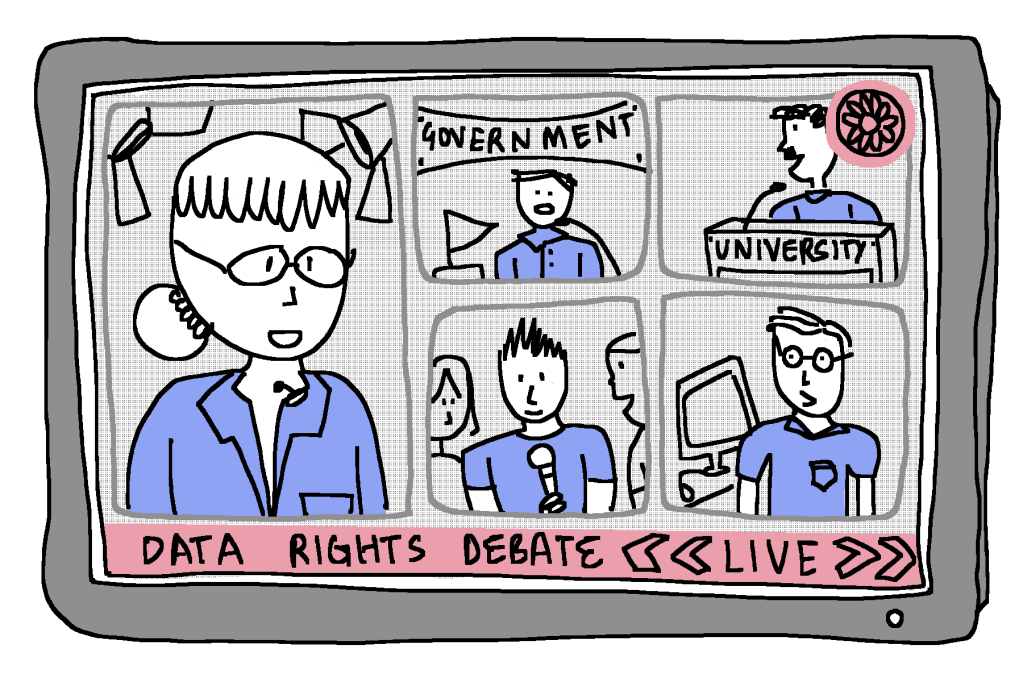
Your roles will be:
TV Anchor: Facilitator of the debate, introduces the topic, assigns roles, and guides the discussion.
Government Representative: Defends the government’s stance on allowing remote proctoring, emphasizing its benefits and regulatory measures to protect data rights.
University Administrator: Advocates for the use of remote proctoring, highlighting the need for exam integrity and fair assessment in an online environment.
Student Activist: Represents the student community, expressing concerns about privacy invasion, algorithmic biases, and the impact on mental health.
Owner of Software: Represents the software used by educational institutes to implement remote proctoring of exams.
Activity Steps:
Research
Participants familiarize themselves with the background information and their assigned roles.
Role Preparation
Each participant prepares key points, arguments, and responses based on their stakeholder role
Mock Debate
Participants engage in a structured debate, with the TV Anchor guiding the flow of discussion. Each participant presents their perspective, responds to others, and raises questions.
Community Discussion
After the debate, open the floor for a community discussion where participants can share their personal opinions, thoughts, and reflections on the topic.
Discussion Points:
Privacy concerns: What are the potential risks associated with remote proctoring?
Equality issues: How can remote proctoring disproportionately affect certain groups of students?
Regulatory measures: What policies and regulations should be in place to safeguard data rights?
Alternatives: Are there alternative assessment methods that address both integrity concerns and data rights?
 CivicAI